The Company regards Corporate Governance as the foundation for sound and accountable business management, beyond merely complying with prevailing rules and regulations. Governance practices have become integral to every process and procedure within the Company. This ingrained culture enables the Company to navigate business challenges, including the highly dynamic challenges of the digital era.
Transparency
Ensure that stakeholders put trust in the Company’s decision making and business processes.
Accountability
Establishing a clear internal function, structure, systems, and accountability to ensure effective and efficient business management in achieving the Company’s interests while considering the interests of Shareholders and other Stakeholders.
Responsibility
Ensuring the Company implements business activities under applicable laws and regulations. The Company is committed to running its business responsibly, with consideration for society, the environment, and all other Stakeholders.
Independency
The Company is professionally managed without conflicts of interest and/or intervention/pressure from other parties that may violate prevailing regulations and is governed on healthy corporate principles.
Fairness
Ensuring fair and equal treatment in fulfilling the rights of Stakeholders arising from agreements and applicable laws and regulations.
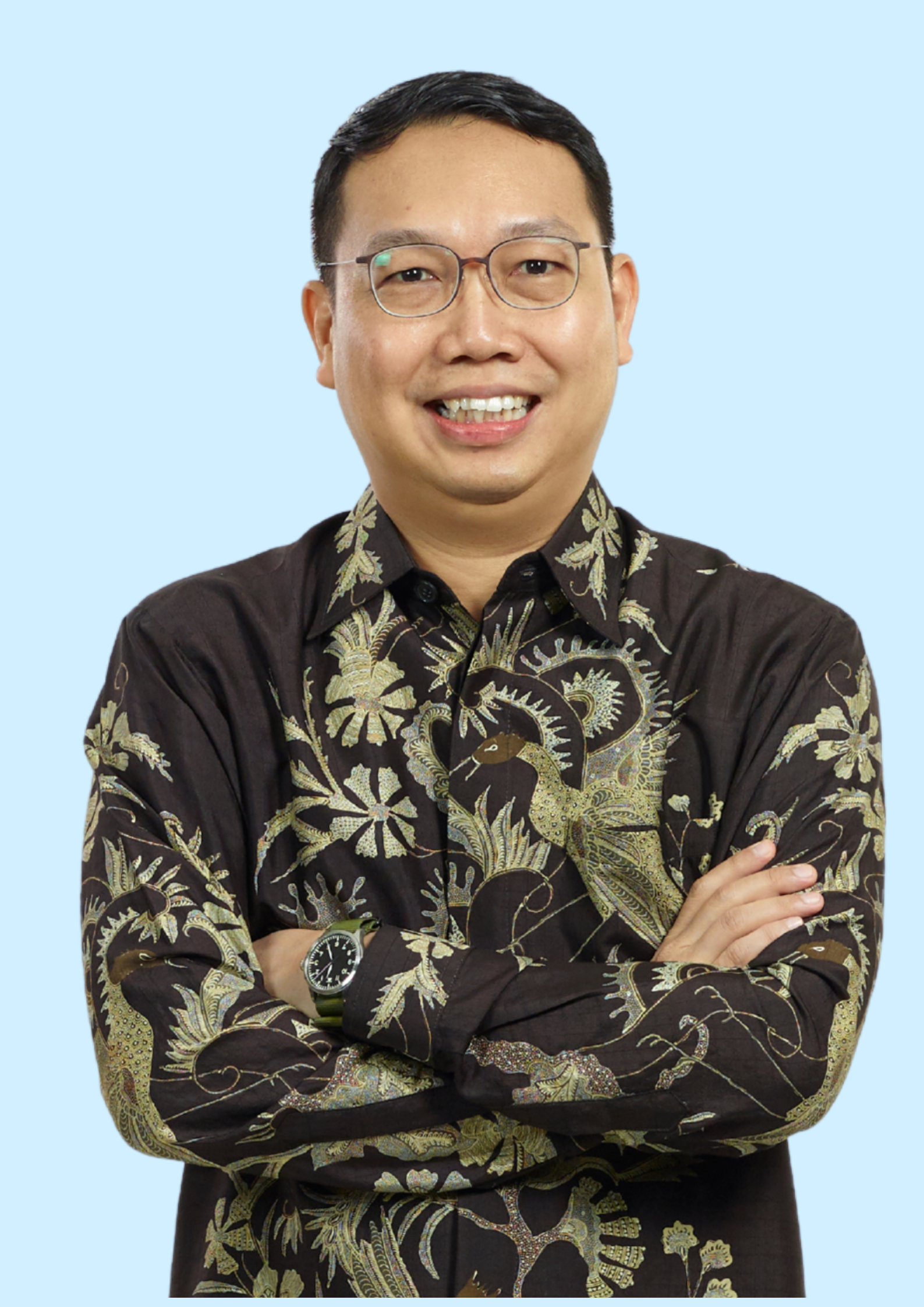
Umbas Rombe was appointed as the Company’s Corporate Secretary on 3 January 2018.
He earned a Bachelor Degree in Law from University of Indonesia. He started his career in 2002 He started his career in 2002 at Benedicta & Associates law firm in Jakarta. Prior to joining the Company, he served as Chief Corporate Legal at PT Grahatama Kreasibaru, Legal Counsel at Quvat Management Pte. Ltd., Legal Manager & Corporate Secretary at PT Salim Invomas Pratama Tbk, and Corporate Legal at PT Dutapalma Nusantara.
The duties and functions of the Corporate Secretary are regulated under POJK 35/2014. The Company has established a blueprint for the Corporate Secretary and Legal Department organization. This blueprint serves as a guideline for the Corporate Secretary, outlining the duties and functions, including:
- With the approval of the Board of Directors, establishing and maintaining relationships with relevant parties to enhance stakeholder loyalty;
- Issuing press releases regarding matters related to the Company;
- Coordinating the prompt preparation of the Company’s quarterly reports, management reports, and annual reports;
- Ensuring the Company’s compliance with applicable laws and regulations;
- Recommending alternative solutions to the Company’s legal issues;
- Recommending the concept of cooperation agreements to be signed by the Board of Directors; and
- Providing legal advice to the Board of Directors in formulating regulations or policies.
Additionally, the Corporate Secretary has supported the Company’s ongoing efforts to enhance good corporate governance and actively participated in the Company’s CSR initiatives and other activities.
.png)
In carrying out its functions and duties, the Board of Commissioners are assisted by two (2) committee with specific duty and authority, namely the Audit Committee and Remuneration and Nomination Committee.
-
Audit Committee
The Audit Committee specifically assign related to transparency in financial reporting to assist the Board of Commissioners in performing and improving internal controls. Audit Committee Composition are as follows:
- Sintong Panjaitan - Chairman
- Chandra Wijaya - Member
- Hertiana Halim - Member
-
Remuneration and Nomination Committee
Remuneration and Nomination Committee was formed to assist the Board of Commissioners in determining compensation and benefits for executives of the Company, as well as the criteria used to determine the annual performance evaluation. Remuneration and Nomination Committee is entitled to propose the remuneration package for the Board of Directors and Board of Commissioners which commensurate with their performance.Remuneration and Nomination Committee Composition are as follows:
- Sintong Panjaitan - Chairman
- Franky Oesman Widjaja – Member
- Head of Corporate Human Resources – Member
In conducting duties and responsibilities, the Board of Directors adheres to the Board Manual as a guide for the Board in performing its functions. The development of this Board Manual is based on corporate law principles, the provisions of the Articles of Association, applicable laws and regulations, directions from Shareholders, and industry best practices.
The Company has obtained an Internal Audit Charter that complies with POJK 56/2015. This Internal Audit Unit Charter serves as a guideline for the Company’s Internal Audit Unit in conducting its duties and responsibilities objectively and independently.
As stated in the Internal Audit Charter, the Internal Audit Unit is accountable to the President Director.
The duties of the Internal Audit Unit are as follows:
- Preparing and implementing the annual Internal Audit plan;
- Testing and evaluating the implementation of internal control and risk management systems under the Company’s policies;
- Conducting audits and assessments of efficiency and effectiveness in finance, accounting, operations, human resources, marketing, information technology, and other activities;
- Giving recommendations for improvements and objective information regarding the audited activities to all management levels;
- Preparing audit reports and submitting them to the President Director and Board of Commissioners;
- Monitoring, analyzing, and reporting on the implementation of recommended corrective actions;
- Collaborating with the Audit Committee;
- Developing a program to evaluate the quality of internal audit activities; and
- Conducting special audits when necessary.
The authorities of the Internal Audit Unit are as follows:
- Accessing all relevant information about the Company related to its duties and functions;
- Communicating directly with the Board of Directors, Board of Commissioners, and/or Audit Committee, as well as members of the Board of Directors, Board of Commissioners, and/or Audit Committee;
- Organizing regular and incidental meetings with the Board of Directors, Board of Commissioners, and/or Audit Committee; and
- Coordinating its activities with those of the external auditor.
From its inception, the Company has had a Code of Ethics that must be upheld by every employee and that contains the noble values of the Company. The Code has been set forth in the form of employee pledge. The complete employees pledge is as follows:
-
We, the employees of PT Plaza Indonesia Realty, Tbk., are determined to develop the trust and credibility of tenants, shareholders, investors, partners, the government, suppliers and the public as stakeholders by:
- Maintaining a commitment to always provide the best service;
- Being honest and having integrity;
- Prioritizing ethics to achieve goals.
-
We, the employees of PT Plaza Indonesia Realty, Tbk. Are determined to work professionally and with dedication for the company by:
- Putting obligations before rights;
- Developing a sense of care for the safety and security of company property;
- Utilizing all available resources in an optimal, effective and efficient manner;
- Investing Corporate funds based on deliberation and prudence;
- Maintaining a work environment that is safe, healthy and comfortable.
-
We, the employees of PT Plaza Indonesia Realty, Tbk., are determined to engage in healthy competition with competitors by:
- Establish pricing strategies based on the best quality commodities, goods or services offered at competitive prices;
- Not making an offers or giving gratuities to tenants and partners to influence decisions;
- Not engaging in monopolistic practices, cartels, and so on;
- Not looking or trying to get information about competitors illegally.
-
We, the employees of PT Plaza Indonesia Realty, Tbk., are determined to avoid a conflicts of interest such as:
- Engaging family members or relatives with an interest in the organization (e.g., relatives or family members who are consultants, competitors or potential competitors to the Company or its suppliers or contractors when there is the opportunity to obtain preferential treatment);
- Being an employee who, or has a family member who, sells, offers or leases their property and does or seeks to do business with the Company;
- Having or seeming to have relationships with competitors, suppliers or contractors;
- Having personal or financial interests or the potential for personal gain in Corporate transactions;
- Accepting gifts, commissions, discounts, gifts or services from customers, potential customers, competitors or suppliers.
-
We, the employees of PT Plaza Indonesia Realty Tbk., are determined to obey the rules and regulations in force, namely:
- Internal regulations set forth in Collective Labour Agreements;
- Generally accepted tax laws and financial reporting standards;
- Regulation of the Capital Market Supervisory Agency and other financial institutions;
- Other applicable regulations in Indonesia.
-
We, the employees of PT Plaza Indonesia Realty, Tbk., are determined to uphold a culture of openness and sincere and honest communication by:
- Providing the opportunity for all employees to speak or express their thoughts and ideas for the betterment of the company;
- Communicating about employee performance appraisals publicly;
- Resolving any issue through communication and deliberation.
-
We, the employees of PT Plaza Indonesia Realty, Tbk., are determined to respect individuals by:
- Appreciating the differences between individuals and differences in ethnic background, social class and religion.
- Providing equal opportunity to all employees based on their professional ability, free of discrimination based on gender, religion or ethnic affiliation;
- Benefitting from these differences to create harmony and a dynamic work environment.


